


Water Tube Steam Boiler
A water tube steam boiler is an industrial steam boiler in which boiler water flows inside the tubes while hot combustion gases pass over the outside of those tubes. That arrangement—opposite to a fire-tube (Scotch) boiler—lets the pressure parts stay in smaller-diameter tubes rather than a large water-filled shell, which suits higher working pressure and high steam capacity.
Ekotek’s water-tube line is the Strong Series liquid/gas-fired D-type steam boiler: steam capacity 2,000–150,000 kg/h, working pressure 6–60 bar, and thermal capacity 1,395–55,800 kW. It is generally preferred when plants need high capacity and higher pressure—typically considered after about 16 bar.
Fuels include LNG, propane, CNG, natural gas, LPG, biogas, hydrogen, gas oil, diesel, fuel oil, and dual-fuel burner packages as specified. Browse the Strong Series card below, or contact us with your steam load, pressure, and fuel data for a sized proposal.


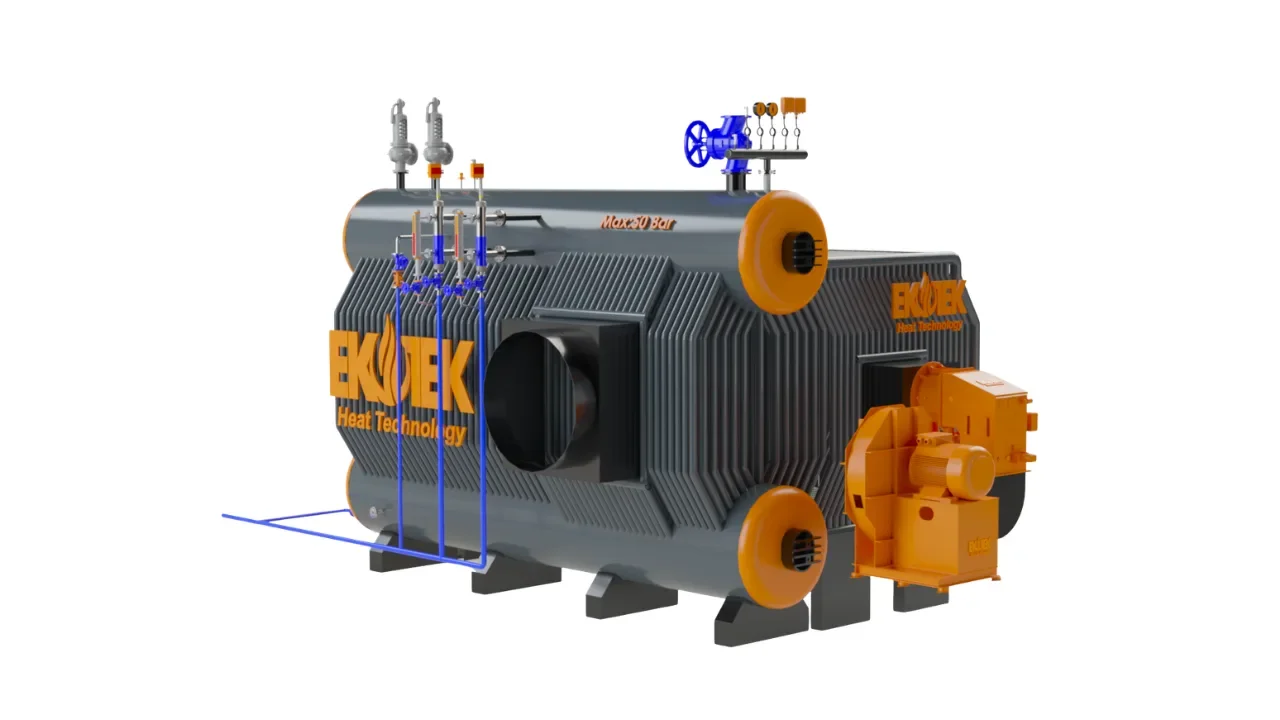
Strong Series - Liquid Gas Fired Steam Boiler
- Steam generation capacity from 2.000 kg/h to 150.000 kg/h
What Is a Water Tube Steam Boiler?
In a water tube (watertube) steam boiler, water and steam circulate inside the tubes. Hot flue gases from the burner travel through the furnace and over the tube banks on the gas side. Heat transfers through the tube walls into the water, which rises into a steam drum; steam is drawn from the drum for the process or power consumers.
In a fire-tube boiler the roles are reversed: combustion gases travel inside the tubes (or furnace tube and passes) while water surrounds them in a large shell. Fire-tube designs such as Ekotek’s Scotch-type steam boilers remain a strong fit for many mid-range industrial loads. Water-tube designs are chosen when pressure, capacity, or load response push beyond what a shell-type fire-tube layout is intended for.
How Does a D-Type Water Tube Boiler Work?
- Firing: A liquid or gas burner fires into a furnace formed largely by water-cooled tube walls.
- Circulation: Water leaves the lower (mud) drum, rises through generating and wall tubes as it absorbs heat, and returns steam–water mixture to the upper steam drum.
- Separation: Steam separates in the steam drum and leaves to the plant header; water returns to the circuit.
- Gas path: Flue gases pass over the tube banks and exit at the rear flue outlet. On the Strong Series the rear outlet includes a flue heat safety sensor.
- Control and protection: A PLC touch-screen HMI with Modbus, TCP, and related protocols (as specified) supervises firing and limits; steam temperature, mechanical and digital pressure, safety valves, and flue temperature controls form the listed safety package, with feed pumps and safety systems in pairs as standard.
The Strong Series is a D-type layout: steam and mud drums sit to one side of a large furnace, with bent tube walls creating the characteristic “D” shape. D-type units are a common industrial water-tube arrangement when high steam capacity and higher pressure are required.
Water Tube vs Fire Tube — Comparison
The table uses qualitative engineering differences plus Ekotek’s published Strong Series figures. Efficiency percentages are not claimed here.
| Topic | Water tube (Strong Series) | Fire tube (Scotch / related) |
|---|---|---|
| Where the water is | Inside the tubes; gases outside | Outside the tubes; gases inside the furnace/passes |
| Ekotek steam range (this page) | 2,000–150,000 kg/h; 1,395–55,800 kW | See steam boilers and Scotch-type product pages for each series |
| Working pressure (Strong Series) | 6–60 bar; generally preferred above ~16 bar | Typically lower-to-moderate industrial bands on Scotch lines (confirm per product) |
| Layout | D-type drums + furnace tube walls | Horizontal Scotch shell, multi-pass fire tubes |
| Load behavior (generic) | Lower water inventory → faster response to demand changes | Larger water volume → more thermal buffering on steady loads |
| Typical selection driver | High capacity and/or higher pressure steam | Proven mid-range process steam with simpler shell layout |
| Fuels (Strong Series) | LNG, propane, CNG, natural gas, LPG, biogas, hydrogen, gas oil, diesel, fuel oil, dual fuel | Depends on series—liquid, gas, solid, hybrid, or electric paths on related pages |
Related fire-tube and fuel paths: liquid fuel steam boilers, solid fuel steam boilers, natural gas steam boilers, hybrid boilers, and compact steam generators.
Strong Series — Liquid/Gas D-Type Water Tube Steam Boiler
The Strong Series is Ekotek’s liquid/gas-fired D-type water tube steam boiler for high-capacity industrial steam:
- Steam capacity: 2,000–150,000 kg/h
- Thermal capacity: 1,395–55,800 kW
- Working pressure: 6–60 bar
- Design: D-type water tube; generally used when high capacity and higher pressure are required (typically after about 16 bar)
- Fuels: LNG, propane, CNG, natural gas, LPG, biogas, hydrogen, gas oil, diesel, fuel oil, dual fuel (as specified)
- Burner: Compatible with universal burners
- Flue outlet: Rear, with flue heat safety sensor
- Controls: PLC touch-screen HMI; Modbus, TCP, and other communication protocols as specified
- Mobile / portable package: Not compatible (stationary industrial installation)
- HS code: 840212000000
- Safety package (product listing): steam temperature, mechanical pressure, digital pressure, safety valve, and flue temperature controls; feed pumps and safety systems supplied in pairs as standard
Exact burner model, drum/tube materials, and auxiliaries are fixed in the project quotation. For burner options see burners.
When to Choose a Water Tube Steam Boiler
- Steam demand in the multi-thousand to hundred-thousand kg/h class (Strong Series: 2,000–150,000 kg/h)
- Working pressure in the Strong Series band of 6–60 bar, especially when the plant is aiming above roughly 16 bar
- Processes that need relatively fast steam response to load swings
- Liquid or gas fuels (including dual fuel) with a universal-burner package
- Sites that already plan rigorous feedwater treatment and trained boiler operation—water-tube circuits are less forgiving of poor water quality than large-shell fire-tube units
If your load sits comfortably in a Scotch fire-tube band, start from Scotch-type steam boilers or the broader steam boilers category. If you need liquid/gas primary heat with electric support, compare hybrid boilers.
How to Select Capacity and Pressure
- Peak and average steam demand (kg/h), including simultaneous consumers
- Required working pressure (bar) and steam quality (saturated vs any superheat needs—confirm at quotation)
- Fuel availability: natural gas, LPG/LNG/propane/CNG, biogas, hydrogen readiness, gas oil/diesel/fuel oil, or dual fuel
- Load profile: steady continuous duty vs frequent turndown and spikes
- Feedwater quality, treatment plant, and condensate return rate
- Boiler-room footprint, rear flue routing, chimney, and foundation limits
- Automation: local HMI vs Modbus/TCP integration into plant PLC/SCADA
- Redundancy: whether paired feed pumps/safety trains (standard on Strong Series) meet site rules
Share these points when you contact us or schedule a consultation. We size the D-type boiler, burner, and auxiliaries together.
Industries and Applications
- Power and large process plants: high-capacity steam headers and turbine or process supply where water-tube pressure/capacity fits
- Chemical and petrochemical: reactors, distillation, and continuous process steam
- Refining and heavy industry: sustained high-pressure steam duties
- Food and beverage: large cookers, evaporators, and plant steam when capacity/pressure call for water-tube rather than Scotch
- Textile and paper: drying, pressing, and finishing steam at scale
- Other high-consumption sites: any facility whose peak kg/h and bar requirement align with the Strong Series range
Related Solutions
- Steam boilers — full steam family overview
- Scotch-type steam boilers — fire-tube alternative for many mid-range loads
- Liquid fuel steam boilers · Solid fuel steam boilers · Natural gas steam boilers
- Steam generators — compact generator footprint when that form factor fits better
- Hybrid boilers — liquid/gas primary with electric secondary
- Industrial boilers — complete product family
- Burners — burner packages
Request a Quote for an Ekotek Water Tube Steam Boiler
Ekotek Heat Technologies manufactures industrial boilers in Aydın, Turkey. Tell us your steam capacity (kg/h), working pressure (bar), fuels, feedwater conditions, and automation needs. We will confirm whether the Strong Series D-type water tube boiler is the right match—or point you to a Scotch fire-tube, hybrid, or steam-generator line when that fits better.
Frequently Asked Questions (FAQ) about Water Tube Steam Boiler
What is a water tube steam boiler?
A water tube steam boiler circulates water inside the tubes while hot combustion gases pass over the outside. That is the opposite of a fire-tube boiler, where gases travel inside the tubes and water surrounds them in a shell. The tube-side water path suits higher pressure and high steam capacity industrial service.
What is the difference between a water tube and a fire tube boiler?
In a water tube boiler, water is inside the tubes and flue gases are outside. In a fire tube (Scotch) boiler, flue gases are inside the tubes and water is in the shell. Water tube units are typically chosen for higher pressure and larger capacity; fire tube units are common for mid-range process steam with a large water volume.
What is a D-type water tube boiler?
A D-type water tube boiler places the steam and mud drums to one side of a large furnace, with water-cooled tube walls forming a “D” shaped layout. Ekotek’s Strong Series is a liquid/gas-fired D-type water tube steam boiler for high capacity and higher pressure service.
What steam capacity does the Strong Series cover?
The Strong Series liquid/gas-fired D-type water tube steam boiler covers 2,000–150,000 kg/h steam capacity, with thermal capacity 1,395–55,800 kW, according to the product technical specifications.
What working pressure does the Strong Series allow?
Strong Series working pressure is 6–60 bar. It is generally preferred when high steam capacity and higher pressure are required, typically above about 16 bar; for lower pressures a fire-tube steam boiler is often the simpler choice.
Which fuels can a Strong Series water tube boiler use?
Listed fuels include LNG, propane, CNG, natural gas, LPG, biogas, hydrogen, gas oil, diesel, fuel oil, and dual fuel. The burner package is specified as compatible with universal burners; the exact fuel train is fixed in the quotation.
When should I choose a water tube boiler instead of a Scotch fire-tube boiler?
Choose water tube when your steam rate and pressure sit in the high-capacity / higher-pressure band (for Strong Series: up to 150,000 kg/h and 6–60 bar, often above ~16 bar), or when faster response to load changes matters. For many mid-range loads, a Scotch-type fire-tube boiler may still be the better fit.
Is the Strong Series mobile or portable?
No. The Strong Series lists mobile/portable boiler system compatibility as not applicable. It is intended as a stationary industrial water tube steam boiler installation.
What controls and communications does the Strong Series include?
The boiler control panel is specified as PLC touch-screen control with an HMI screen, plus Modbus, TCP, and other communication protocols as configured for the project.
What safety systems are listed for the Strong Series?
The product lists five safety control groups: steam temperature, mechanical pressure, digital pressure, safety valve, and flue temperature controls. Feed pumps and safety systems are supplied in pairs as a standard package. The rear flue outlet includes a flue heat safety sensor.
Can a water tube steam boiler be supplied with its feed pumps and safety devices?
Yes. For the Strong Series, boiler feed pumps and the safety systems are provided in pairs as a standard package. On request, Ekotek steam boilers can also be delivered as a package with their accessories; share your scope when you ask for a quote.
What information do you need for a water tube steam boiler quote?
Send peak and average steam demand (kg/h), required working pressure (bar), available fuels, feedwater/condensate details, load profile, site space and flue constraints, and automation needs (HMI only vs Modbus/TCP). Use Contact us or Schedule a consultation—context from this category page is included with the request.
Water Tube Steam Boiler Get a Quote
Contact us for more details about the product, solutions and services.
- Share your full name, company, and contact details to receive a fast response for this product category.
- The category and page context are added to the message so your request reaches the relevant sales team.
- You can contact our team directly for product selection, technical details, quotation, and application scope.
Requests submitted from this category page Water Tube Steam Boiler are delivered together with the page title.